
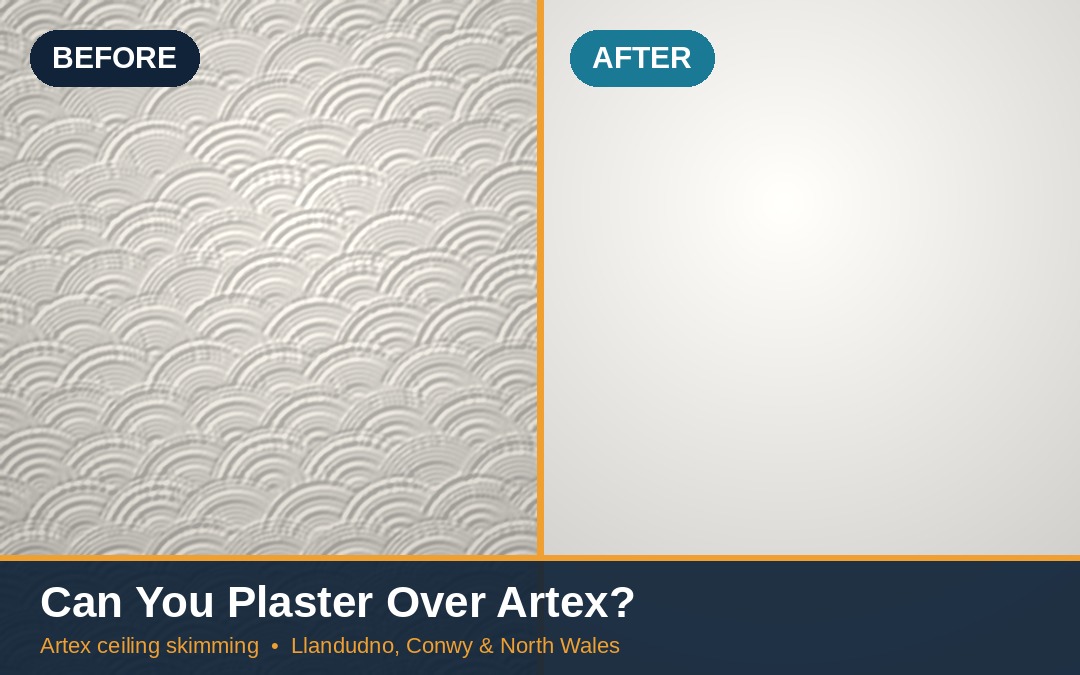
Swirls, stipples, fans and peaks: if you live in an older home in North Wales, there’s a good chance at least one of your ceilings is covered in Artex. It was hugely popular from the 1960s through to the 1990s, and plenty of properties in Llandudno, Conwy, Colwyn Bay and Deganwy still have it today.
Most homeowners now want a smooth, modern finish instead. The good news is that yes, in most cases you can plaster over Artex. But there are a few important things to know before you start, especially about safety.
What Is Artex?
Artex is actually a brand name, but it’s become the everyday word for any textured coating applied to ceilings and walls. It was used because it was quick to apply, hid cracks and uneven surfaces, and was seen as decorative at the time.
Today, textured ceilings tend to make a room look dated, collect dust and cobwebs, and are awkward to repair or paint neatly. That’s why removing or covering Artex is one of the most common jobs we’re asked about.
Check for Asbestos First
This is the most important step, and it should never be skipped.
Many older textured coatings contained a small amount of asbestos. It was only fully banned in the UK in 1999, so any Artex applied before 2000 could contain it. You cannot tell by looking at it.
Asbestos in Artex is generally low risk as long as it’s left undisturbed. The danger comes from sanding, scraping, drilling or knocking off the texture, which can release fibres into the air.
Before any work starts, we strongly recommend getting a sample tested. Testing is inexpensive and quick, and it tells you exactly what you’re dealing with. Never sand or scrape Artex yourself until you know it’s safe.
If your Artex does contain asbestos, plastering over it is often the preferred option, because it seals the coating in place without disturbing it.
How Is Artex Plastered Over?
A professional plasterer will usually follow these steps:
- Inspect the surface. Check the ceiling is sound, with no loose, flaking or damp areas.
- Clean the surface. Remove dust, grease and any loose material so the plaster bonds properly.
- Apply a bonding agent. Artex is very smooth and non-absorbent in places, so a bonding coat is applied to give the new plaster something to grip onto.
- Fill the texture. Heavily textured patterns such as deep swirls or peaks often need a base coat first, to fill the pattern and create a level surface.
- Apply a skim coat. A final finishing coat of plaster is trowelled on to create a smooth ceiling that’s ready to paint once dry.
The result is a clean, flat ceiling that looks like it was never textured in the first place.
Other Options for Artex Ceilings
Skimming isn’t the only choice. Depending on the condition of your ceiling, you might also consider these options:
- Overboarding. New plasterboard is fixed over the existing ceiling and then skimmed. This is a good option if the ceiling is uneven, cracked, or the texture is very heavy.
- Removal. The texture can be removed, but this is messy and time-consuming. If asbestos is present it must be handled safely by the right specialists, so it’s rarely the easiest route.
We’ll always advise on the best option for your ceiling and budget after seeing it in person.
Can I Plaster Over Artex Myself?
It’s possible, but it’s one of the harder plastering jobs to get right. Ceilings are physically demanding to work on, and achieving a flat, smooth finish over a heavy texture takes real skill. Poor bonding can also lead to cracking or the new plaster coming away later.
There’s also the safety issue. Without testing, you risk disturbing asbestos without knowing it. For most homeowners, it’s worth getting a professional in for a finish that lasts.
How Long Does It Take?
A typical room ceiling can often be skimmed in a day, though heavily textured ceilings or overboarding can take longer. The fresh plaster then needs time to dry before painting. See our guide on how long plaster takes to dry and when you can paint.
Artex Ceiling Plastering Across North Wales
Paul Hughes Plastering covers Artex skimming and ceiling plastering throughout North Wales, including:
- Llandudno and Craig-y-Don
- Conwy and Deganwy
- Llandudno Junction
- Colwyn Bay and Rhos-on-Sea
- Penrhyn Bay and surrounding areas
Whether it’s one dated ceiling or a whole-house refresh, we can advise on the best approach and give you a clear quote.
Ready to say goodbye to your Artex? Call Paul on 07902 845848 or get in touch here for a free, no-obligation quote.
Frequently Asked Questions
Can you skim straight over Artex?
Usually yes, once the surface is clean, sound and treated with a bonding agent. Deep textures may need a base coat first.
Does all Artex contain asbestos?
No, but any textured coating applied before 2000 could. The only way to know is to have a sample tested.
Is it cheaper to skim or remove Artex?
Skimming over is usually quicker and more cost-effective than removal, and it avoids disturbing the coating.
Can you plaster over Artex on walls too?
Yes, the same process applies to textured walls as well as ceilings.
Need a plasterer in Llandudno or North Wales?
Paul Hughes has 25 years' experience of plastering and patch rendering. Free, no-obligation quotes.